Use case: a synthetic focus group on French news, without predicting 2027
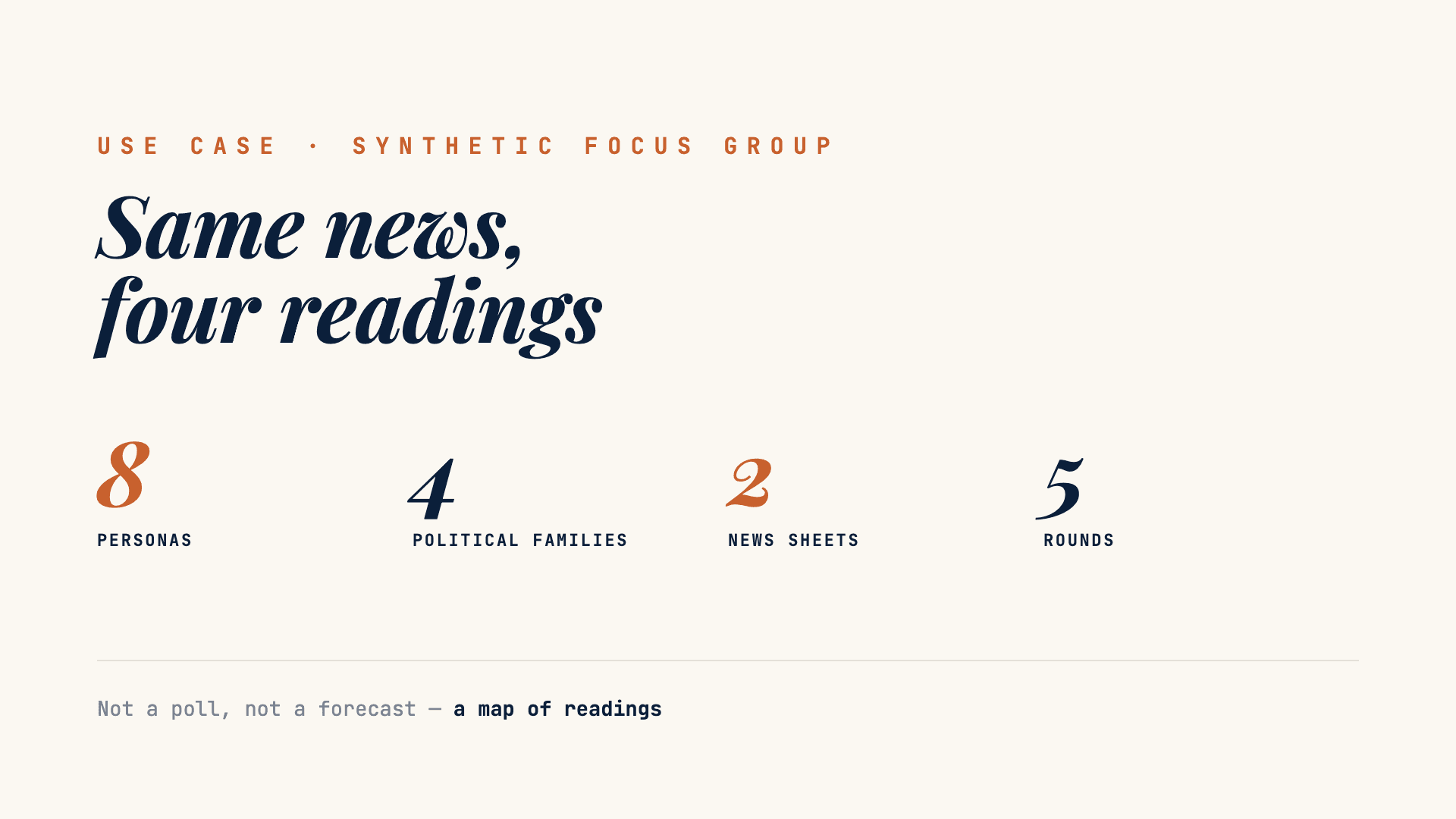
Eight synthetic personas from four political families read the same two news sheets, first alone, then together. Where they agree, where they split, and what it cannot tell you.
En français — Focus group synthétique : que teste-t-on quand les personas ne connaissent pas l’actualité ? (version française)
In October 2026, French news was full of school walkouts, inflation and public debt, six months before a presidential election. What happens when people who do not share the same politics read exactly the same facts? We ran the question past eight synthetic personas, alone first, then together.
In short
- Eight personas, two from each of four political families, read the same two dated news sheets. No news feed, no outside sources.
- Everyone answered alone before seeing the others, then the discussion opened.
- They agree on the diagnosis: schools, healthcare, the cost of living. They split on causes, on what counts as a legitimate protest, and on what public debt means.
- It is a map of readings, not a poll and not a forecast.
The setup
Where they agree
Before any sheet, two worries run across every political family: public services getting worse, schools and healthcare above all, and day-to-day money pressure. Everyone shares the diagnosis. The causes they blame and the fixes they propose are another matter.
On the student protest sheet, one detail lands with almost everyone: teachers on long absences who are not replaced. It is concrete, hardly anyone disputes it, and it makes the students’ frustration understandable, even to the personas most hostile to school blockades.
« Pour moi, une mobilisation est légitime quand elle défend des choses concrètes qui ne marchent plus, comme ces profs pas remplacés dont on parlait. »Synthetic persona · national right
Verbatims are kept in French, the language of the discussion.
Where they split
Blockades: an obstacle, or the last resort?
On the right and in the centre, blocking a school means stopping others from studying. On the radical left, it is the only way to be heard when the usual channels go nowhere. The hesitant social democrat understands the anger but rejects systematic blockades. The disagreement is not about the measure; it is about what a legitimate protest is.
Debt at 119% of GDP: a constraint, or an argument?
The figure shocks almost everyone. Then the readings part ways. For the right and the centre, it is a real limit on new spending. For the radical left, it is a bogeyman used to justify underinvestment. Same number, different priorities.
« On ne peut pas continuer à promettre des investissements massifs partout sans dire comment on les finance. »Synthetic persona · centre
« Ce que je veux dire, c’est qu’on nous présente la dette de 119 % comme une loi de la nature indiscutable, alors que c’est un choix politique. »Synthetic persona · radical left
A signal across the board
The education ministry’s promised “dialogue sessions” are met with distrust by nearly the whole group, for opposite reasons. Some see talk replacing firmness; others see a way to buy time without putting in money. For anyone preparing a public message, that is a hypothesis worth checking: announcing a consultation without a measurable commitment may win over no one.
Everyone rejects the same answer. Not for the same reasons.
The next question
Almost every persona invokes “efficient public spending”, and none says what they mean by it. As long as each side puts something different behind the same words, agreement is only apparent. That is the next question to ask, and a concrete trade-off (less debt, fewer teachers hired) would bring real priorities to light.
One more observation: after hearing the others, no persona really changed position. References to others mostly served to confirm their own view.
What this case cannot tell you
Frequently asked questions
Did the personas know the news?
No. They were not given a news feed. The events were summarised in two dated fact sheets written for the study, with their sources. That limits the effect of whatever the model may have absorbed, without making the answers neutral or comparable to real citizens.
Is this a poll on the 2027 French presidential election?
No. It measures no voting intention and gives no electoral estimate. It explores how different political sensibilities read the same facts.
Why ask each persona alone before the discussion?
To separate the first reaction to the material from what the group adds later. Reading both side by side shows what holds, what shifts, and what the discussion may have amplified.