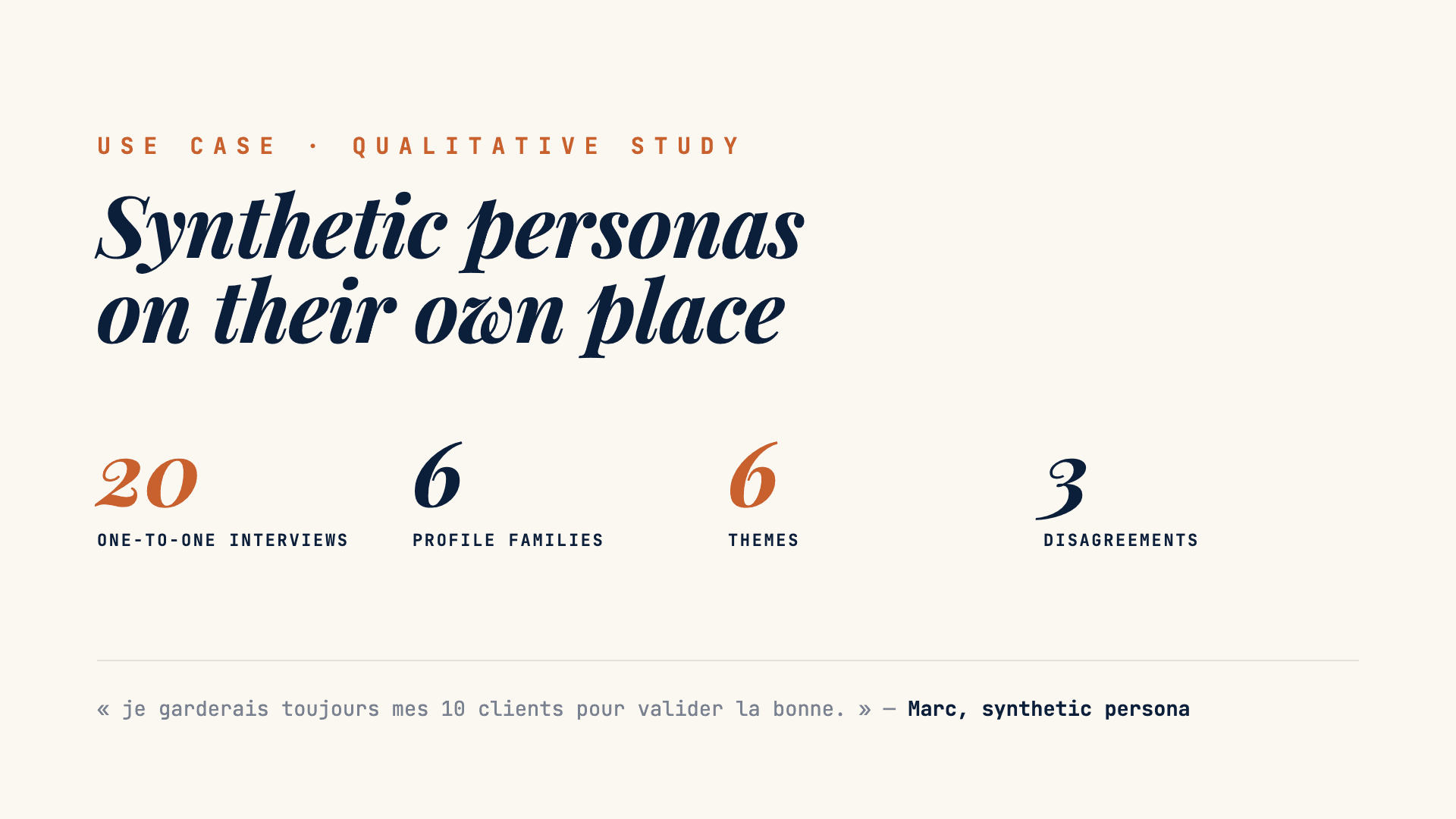
Use case: twenty synthetic personas on their own place in market research
We asked twenty synthetic personas whether synthetic personas can replace human respondents. Not the polite yes you might expect: their conditions, their objections, and what the study cannot say.
En français — Cas d’usage : vingt entretiens individuels avec des personas synthétiques (version française, avec un entretien complet)
We asked twenty synthetic personas a slightly awkward question: can synthetic personas replace human respondents in market research? You might expect a polite yes. The interviews say something else.
In short
- Twenty one-to-one interviews across six profile families, from marketing directors to wary consumers.
- Fifteen end up on complementarity: synthetic to explore and sort, human fieldwork to decide. Two would hand almost everything to simulation. Three refuse substitution outright.
- The risk they mention most is not error, it is the echo chamber (12 of 20): brands that only ever talk to simulations.
- They set their own conditions: check against reality, verify on a small human sample, say where the answers come from.
The decision at stake
The decision was ours: how to present a synthetic persona app to research and marketing professionals. As a substitute, or as a complement? For which uses, with which limits, on which conditions?
The setup
Six themes
| Theme | What the panel says | Profiles |
|---|---|---|
| The unexpected | Hesitation, contradiction, the weak signal outside the script: simulation misses them. Even the tech enthusiasts agree. | 18 / 20 |
| Explore, don’t decide | Synthetic is for testing hypotheses and weeding out obvious mistakes. The final call belongs to human fieldwork. | 16 / 20 |
| The echo chamber | Brands that only talk to simulations would confirm their own biases in a closed loop. | 12 / 20 |
| Conditions of credibility | Check against real data, verify on a human sample, say where the answers come from. | 9 / 20 |
| Lukewarm by design | Products and campaigns optimised to offend no one, and to move no one. | 8 / 20 |
| Transparency | An undeclared simulation feels like a betrayal. Saying so is the bare minimum. | 7 / 20 |
Where they land
By the end, fifteen profiles argue for complementarity. Two, a customer data manager and a young AI power user, would hand almost everything to simulation. Three consumers refuse substitution. The synthesis names them rather than melting them into an average.
« Au fond, je pense que j’utiliserais les 1 000 machines pour éliminer les mauvaises idées, mais je garderais toujours mes 10 clients pour valider la bonne. C’est une question de dosage. »Synthetic persona · Marc, small business owner
« Si on simule 100 parcours, on doit en vérifier au moins 3 ou 5 avec de vraies personnes pour valider que les signaux faibles détectés par l’IA ne sont pas des hallucinations ou des simplifications. »Synthetic persona · Inès, service designer
« Mais une IA qui utiliserait ma sincérité pour apprendre à simuler la sincérité, c’est du vol d’identité émotionnelle. »Synthetic persona · Fatou, mother
Verbatims are kept in French, the language of the interviews.
Three open disagreements
Speed and cost, or the truth of the field?
Marketing and tech profiles accept the trade-off for early stages. Consumers and the most seasoned researchers refuse it, because they think it leads to full substitution.
Is a machine’s “no” worth anything?
For some, the machine is more honest because it is not trying to please. For others, its “no” is worthless, since it puts no career, no budget and no life on the line.
Simulated contradiction: depth, or caricature?
Analytical depth for the tech and design profiles; caricature for the qualitative researchers and the consumers.
Sort with the machine, validate with people.
One unexpected lead comes from the service designer: on painful topics such as over-indebtedness, simulation could spare vulnerable people from reliving an ordeal, before going to meet one or two of them with more care.
What this case cannot tell you
Frequently asked questions
Isn’t it odd to ask synthetic personas about synthetic personas?
It is, and that is the point. You might expect a polite yes. The interviews say something else, with nuances worth reading, and they draw their own conditions of use.
Does this tell us what market research professionals think?
No. The twenty profiles were chosen to cover the range of views, not drawn from a population. The study maps reasoning and objections; it does not count opinions.
Where can I read a full interview?
The French version of this case publishes one interview in full, with Manon, a qualitative researcher and one of the toughest critics of the tool.