Intermarché Terroirs: what a storyboard pretest would have shown
We took the film “Ces dimanches-là” back to storyboard stage and showed it to twenty synthetic personas. The emotion lands; proof, products and price still need work.
En français — Intermarché Terroirs : ce qu’un pré-test sur storyboard aurait montré (version française)
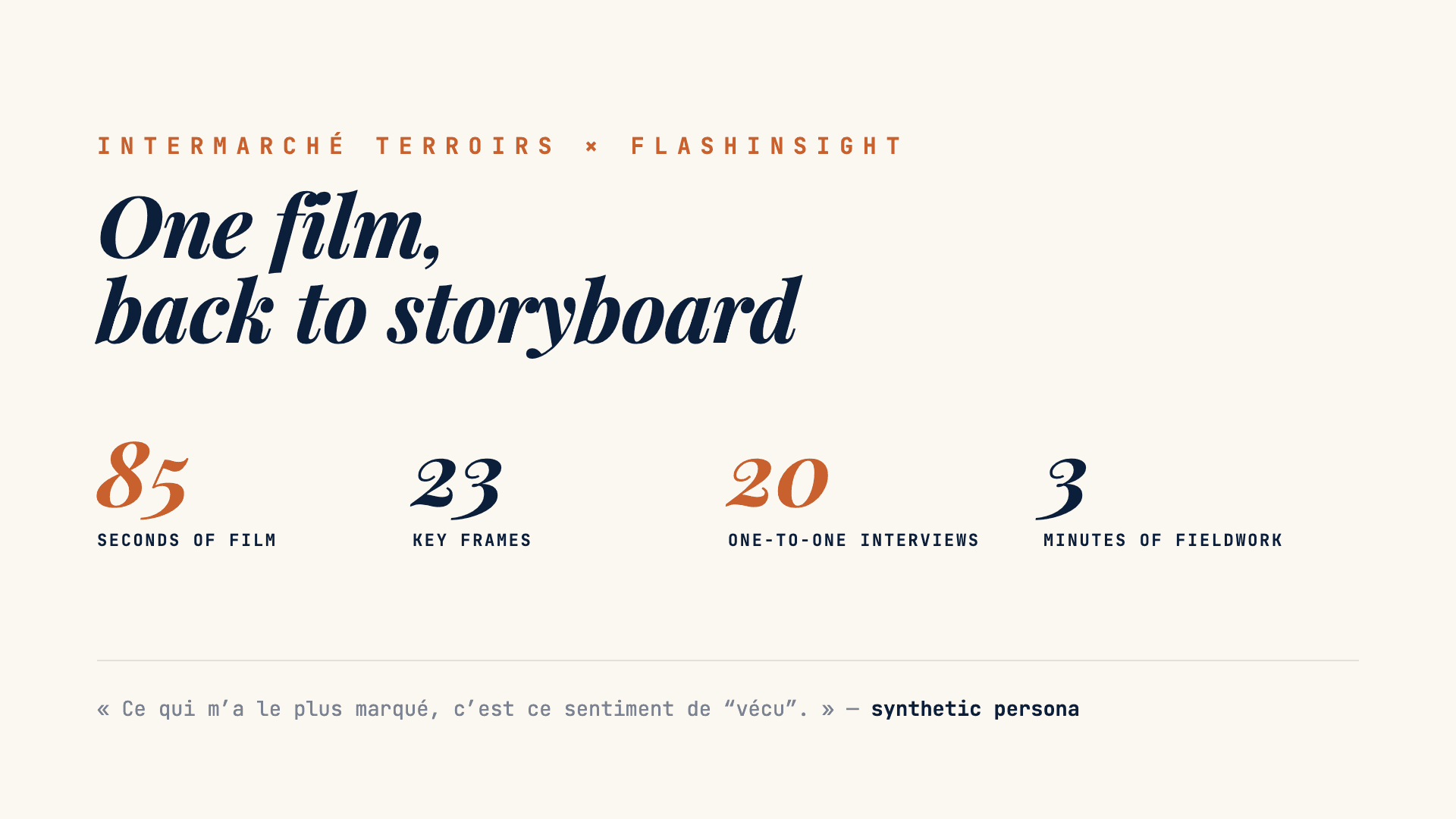
On 4 October, French retailer Intermarché launched “Ces dimanches-là” (Those Sundays) for its Terroirs range: 85 seconds of a 1970s-style family lunch, a burnt roast, oysters “from René’s”, and the line “Some things change, others don’t. And that’s just as well.” Six days later, we asked what a pretest would have said before the shoot.
In short
- We took the film back to storyboard: 23 frames and the script, no sound.
- Twenty synthetic personas discovered it in one-to-one interviews. None had seen it.
- The emotion lands with everyone. The questions are about proof, where the products sit, and price.
- Our February test of “Le Mal-Aimé” was already saying the same thing.
A study we ran on our own initiative, with no link to Intermarché or its agencies.
The setup
What moves them
Everyone is moved, from the very first reaction. The personas talk about happy nostalgia, about their own family lunches, about characters who tease each other. Above all, they like that it is not perfect.
« Ce qui m’a le plus marqué, c’est ce sentiment de “vécu”. »Synthetic persona · one-to-one interview
« C’est rassurant de voir des images qui ne font pas “publicité papier glacé” avec des gens parfaits. »Synthetic persona · one-to-one interview
Verbatims are kept in French, the language of the interviews: they talk about a feeling of real life, and images that are not glossy ads with perfect people.
Everyone reads the message the same way: food as the glue of the family. The end line comes back in their own words. And “Terroirs” means taste, French origin and know-how to them.
Where they split
A real memory, or a postcard?
Most of them recognise themselves in this noisy lunch. A few, often younger or not customers, find it too good to be true: real life does not leave much time or energy for parties like that.
For Sundays, or for every day?
The big lunch puts the range in the special-occasion box. The most budget-conscious wonder whether it costs more, and whether these products are meant for weekdays. They want to take a look, but the shelf will decide.
What they want: proof
They believe the promise, but want to see it: a producer, a region, a method. The example they give is the line about René’s oysters. Yet according to Ouest-France, no shop and no oyster farmer goes by that name in Agon-Coutainville. The detail rings true, and that is exactly the kind of detail the personas would like to see attached to the products.
Three more remarks keep coming back. The jump from the lunch to the product end card is too abrupt, from a moving, funny family story to a very “in-store” product shot. The products are barely visible at the table. And the beach scene loses several of them.
From the wolf to Sunday lunch: why test early
“Ces dimanches-là” follows “Le Mal-Aimé”, Intermarché’s 2025 Christmas tale, made by the same agency, Romance. The wolf who learns to cook was watched around a billion times in a few days, according to The Conversation, and the retailer is now announcing 700,000 wolf plush toys for Christmas.
We tested “Le Mal-Aimé” in February, quantitatively, with 60 and then 65 personas. That test already said four things: very strong emotion, an “eat better” message everyone understood, a brand less memorable than the story, and a gap between wanting and going to the store. The scores back then were too tightly bunched to quote (that was before our work on under-dispersion), but the signals were clear.
Two films, one lesson: emotion is won in the story; the store visit is won on brand, proof and product.
Those are exactly the things you can still move at storyboard stage: a product on the table, a named producer, the brand showing up earlier. After the shoot, it costs more, and it is often too late.
What this case cannot tell you
A small irony we are happy to own: synthetic personas reading a campaign whose strength is authenticity. All the more reason to check their reading against real people. The full report is available on request.
Frequently asked questions
Did Intermarché commission this study?
No. We ran it on our own initiative, with no link to Intermarché or its agencies, using the film as it airs. It is here to show the method, not to judge the campaign.
Why test a storyboard rather than the film?
Because that is when everything can still change: the order of scenes, where the products appear, the proof, the end line. We took the film back to that stage to see what a pretest would have said. Music and pacing are therefore not tested.
What does this have to do with “Le Mal-Aimé”?
Both films put emotion before product. Our test of “Le Mal-Aimé” in February 2026 already showed what the Terroirs storyboard shows: the story moves people, and it is the brand, the proof and the product that decide whether they go to the store.