 Dr Laurent Florès
Small business market research: a real example, from first question to offer ideas
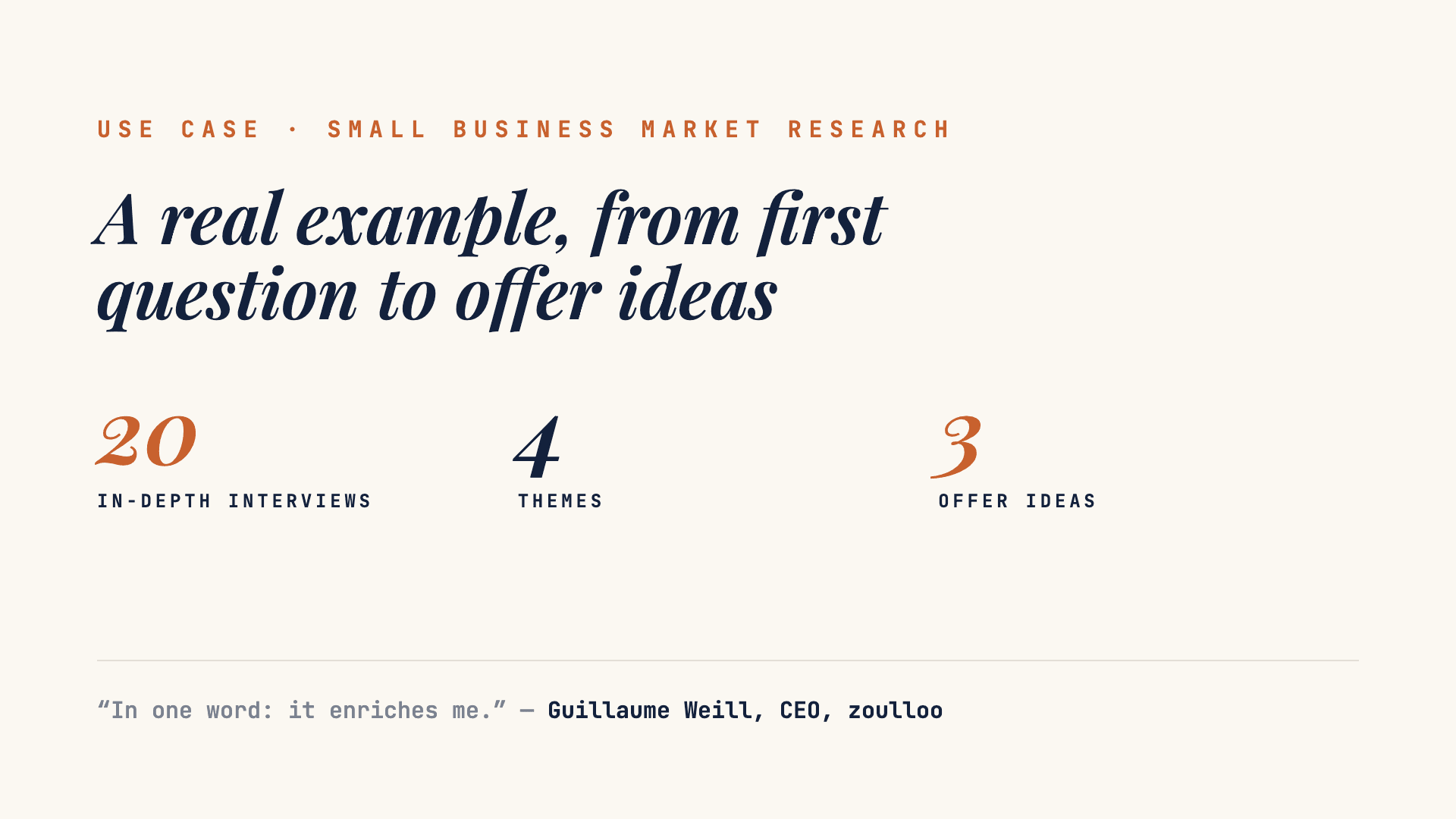
A real example of market research for a small business. zoulloo wanted to break into a new segment: data leaders at large companies. Before pitching them, it ran twenty in-depth interviews with simulated clients. Here is what they said, the three offer ideas that came out of it, and what zoulloo’s CEO made of it.
En français — Exemple d’étude de marché : une PME teste une nouvelle cible avant de la démarcher (version française)
Guillaume Weill is the CEO of zoulloo, a platform that matches companies with freelance experts in market research, data and analytics. In June 2026 he set his sights on a new segment: data leaders at large companies. Before pitching them, he wanted to know what they actually need. Here is the study, what it found, and what he made of it: a real example of market research for a small business, from the first question to the offer ideas.
At a glance
- The question: what do data leaders want when they bring in outside experts?
- The setup: twenty in-depth interviews with simulated clients, all data, BI and analytics leaders in French banking, retail and e-commerce.
- The findings: they are tired of interchangeable profiles, they want experts who get the business, and they refuse to depend on a third party.
- The verdict from Guillaume Weill: “3 ideas I had not thought about before.”
The decision behind it
zoulloo knows insight and research teams well. Data teams were next door: strategic, but less familiar. What frustrates them? How do they choose a partner? Where does a specialist fit next to freelance platforms, consultancies and IT service firms? A traditional qualitative study among these hard-to-reach executives costs more than most small firms can spend.
How it was done
Each simulated client has a role, a sector, years of experience and a starting point, and answers the way someone in that role would. The interviews ran in French, so the quotes below are in the original. For the method, see our glossary entry on synthetic research.
What we heard
Enough with interchangeable juniors
The same complaint keeps coming back: providers who send junior profiles with no feel for the business, and leave the client to manage them.
« J'en ai un peu assez des grandes ESN qui m'envoient des profils juniors interchangeables pour faire du "body shopping". »Simulated client · Chief Data Officer, retail bank
They want people who get the business
Technical skill is now a given. What they want is someone who can connect the data to the decisions in their sector, and explain it.
« Je cherche des gens qui savent naviguer entre l'IT et les directions métiers sans que j'aie besoin de faire la traduction à chaque réunion. »Simulated client · Chief Data Officer, banking group
« On consomme de la ressource technique, mais on manque de partenaires qui pigent vraiment les enjeux d'un pure player e-commerce. »Simulated client · Head of Data & Analytics, e-commerce
Knowledge has to stay in-house
An outside expert who walks away with what they learned is seen as a loss, not a service.
« Je ne veux pas que la "recette" de nos indicateurs de performance dépende d'un tiers. »Simulated client · BI Director, grocery retail
« Dès qu'un freelance trouve une mission mieux payée ou plus proche de chez lui, il part, et il emmène avec lui toute la connaissance qu'il a accumulée sur nos flux logistiques. »Simulated client · Head of Data & BI, online retail
Speed versus continuity
This is the core tension: they need help right now, yet every change of provider sets them back.
« Si j'ai un problème de tracking sur une campagne qui démarre demain, je ne peux pas attendre trois mois. »Simulated client · Digital Analytics Director, e-commerce
« C'est pratique, ça va vite, mais je commence à en voir les limites : on manque parfois de suivi sur le long terme, et je me retrouve souvent à devoir réexpliquer nos process à chaque fois qu'on change de prestataire. »Simulated client · BI Director, retail and e-commerce
They don’t want another profile. They want an expert who understands their business and leaves the knowledge behind.
Three ideas for the offer
- Position as a “bilingual” partner, equally at home with the tech and the business, and prove it in the first meeting by talking about the client’s own KPIs.
- Guarantee the handover: documentation, pairing with the in-house team and a planned exit, to take the fear of lock-in off the table.
- Lead with a short diagnostic: a few days to look at the data and deliver a roadmap before any long-term commitment.
These are hypotheses to test, not conclusions. They were then turned into three offers and put to a group of eight simulated decision-makers.
What Guillaume Weill says
“Delivering 3 ideas I had not thought about before.”
“We’re not, yet, a company that could afford spending 10K on a qual research on our customers. And there are millions of companies like us. They also need insight and research.”
“I’m able to iterate with these synthetic personas to help me think and validate later with ‘real’ customers. In one word: it enriches me.”
“I encourage you to do the same, whatever the size of your company, even and most importantly if you’re on your own.”
 Guillaume Weill, CEO of zoulloo. From his LinkedIn post of July 2026, lightly trimmed.
What this example can’t tell you
Frequently asked questions
What makes a good market research example for a small business?
One that starts from a real business decision, shows who was interviewed and how, then what came out of it: needs, frustrations, the target’s own words and the ideas they lead to. A fill-in-the-blanks template shows none of that.
Can a small business do market research on a tight budget?
Yes, to get started: pull together public data on your sector, look at your competitors, then listen to your target. Interviews with simulated clients help you prepare; you still need real customers to validate.
Do simulated clients replace real ones?
No. They help you think things through, find the right questions and spot objections before you talk to real customers. That is exactly how Guillaume Weill describes using them.
Terms in this example
- Synthetic respondent — An instance of a model asked to answer questions as a human would, calibrated on data describing a real population. The output — the unit a sample is made of.
- Synthetic persona — The briefing given to the model: the traits, attitudes and characteristics that steer its answers. A specification, not a person.
- Synthetic research — Market research in which the answers come from simulated respondents, built from a real population, instead of being collected from a human panel.