Synthetic Personas vs Digital Twins: One Word Changes the Evidence You Owe
They are sold as the same product. They are not the same claim — and the stronger claim now has the worse published record.
Two words are used as if they were interchangeable, and the substitution almost always runs one way: what a vendor built is a persona, what a vendor sells is a twin. The upgrade is free in a slide and expensive in a decision, because the second word commits you to a kind of evidence the first one never required.
The difference in one line
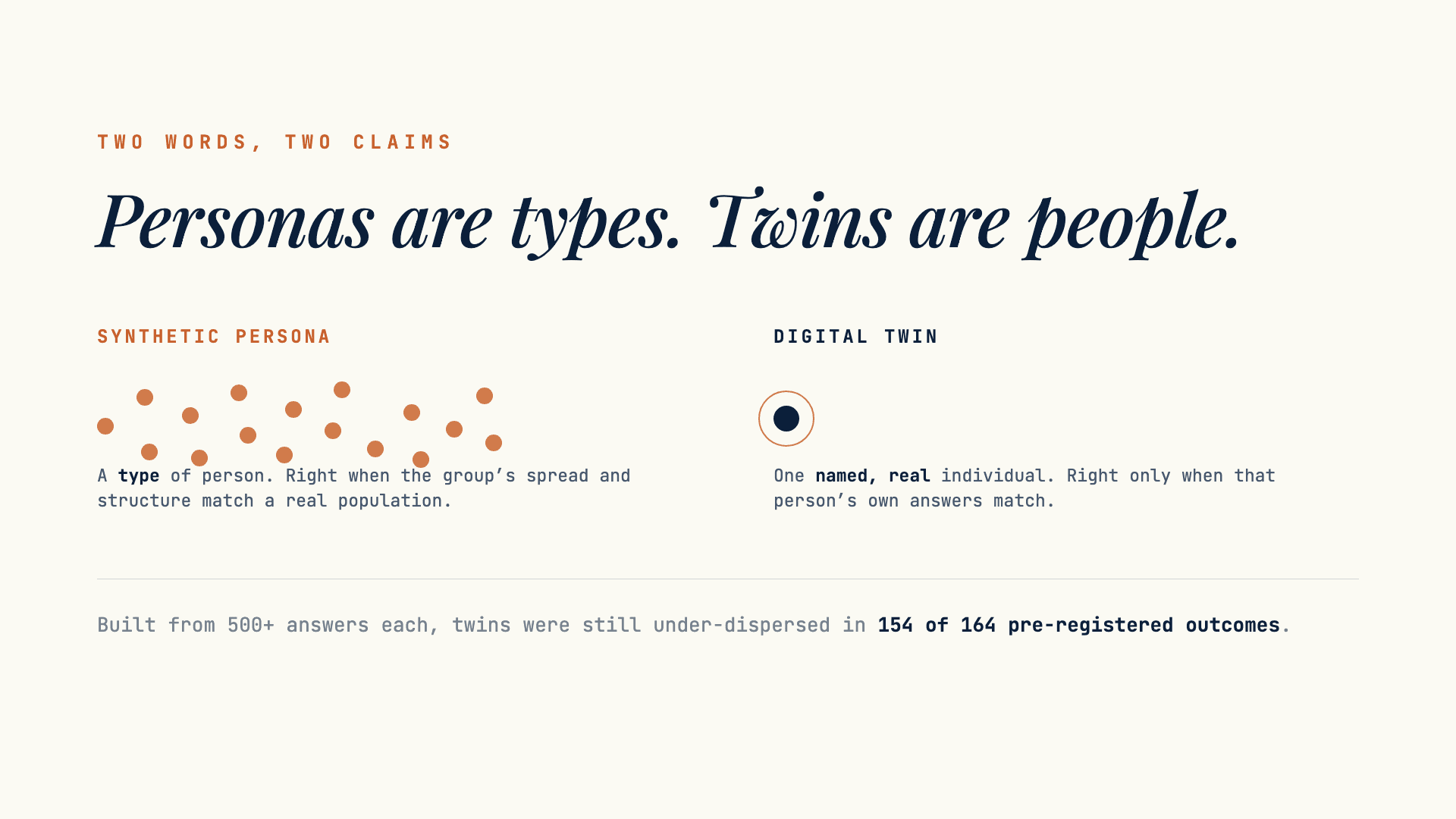
A synthetic persona is a briefing. It describes a type of person — traits, attitudes, circumstances — and asks a model to answer in character. A digital twin claims to replicate a specific, real individual, usually someone who has already answered a great many questions about themselves.
Archetype versus individual. That is the whole distinction, and it is not a matter of sophistication. A very elaborate persona is still an archetype. A crude twin is still a claim about one named human being.
A persona is right when the distribution is right. A twin is only right when a particular person is right.
Why the word changes what you must prove
The evidence bar moves with the claim, and it moves a long way.
| Synthetic persona | Digital twin | |
|---|---|---|
| Unit of the claim | A segment or archetype | One named, real individual |
| Input needed | Population data and a briefing | That person’s own prior answers, at length |
| What “accurate” means | The spread and structure of the group match a real group | This person’s answers match their answers |
| How you check it | Against a real survey of the same population | Against the same person, held out and re-asked |
| Failure you should fear | A group too uniform to contain disagreement | A confident portrait of someone who does not exist |
Notice the last row. A persona that is wrong gives you a blurry average. A twin that is wrong gives you a sharp, named, quotable answer attributed to a real customer. The second failure is much harder to catch, because it arrives looking like evidence.
What the strongest twins actually managed
This is no longer a question of opinion. The best-documented attempt at digital twins is public, and it was published by the team that built the technology rather than by a critic.
In September 2026, Science Advances published “Digital twins are funhouse mirrors” from Columbia Business School: nineteen pre-registered studies, 164 outcomes, real people compared against twins built from more than 500 of each person’s own answers. That is the favourable case — the richest individual input anyone has worked with, on the Twin-2K-500 dataset. Their first named distortion:
The SD of the twin responses is lower than that of human responses in 154 of 164 cases (93.9%), indicating underdispersion in twin responses.
And the finding that belongs with every citation of that paper, including ours: on 105 of the same 164 outcomes, the twins’ average answer differed significantly from the human one. Not just too agreeable — displaced.
Read that against the table above. If five hundred answers per person are not enough to reach individual fidelity, then a persona built from population statistics and a paragraph of briefing is not a twin, whatever it is called on the slide. The word is doing work the method cannot do.
Which one do you actually want?
Usually the persona — and that is not a consolation prize. Most research questions are about groups. Which concept wins. Whether a price lands. What a segment objects to. None of those need a named individual; they need a group whose internal disagreement is real, which is a demanding requirement in its own right and the one we found ourselves failing.
You want a twin when the decision is genuinely about one person or one account — a key-account simulation, a longitudinal panel where the same respondent must be re-contacted, a personalisation model. Those are real needs. They are also rarer than the vocabulary suggests.
Three questions that settle it
- Whose answers built this?If the input is census data, segmentation and a brief, it is a persona. If it is one person’s own prior responses, it is a twin. There is no third answer.
- What was it checked against?A persona is checked against a real survey of the same population; a twin against the same human, held out and asked again. A vendor who validates a “twin” against group averages has validated a persona.
- How much do they disagree with each other? Ask for the answers at respondent level and compare the spread inside a subgroup with a real survey. This is the single check that catches the most, and it works on either claim. We set it out in a test anyone can run.
The honest summary is that the stronger word currently has the weaker record. That should make buyers suspicious of the upgrade, not of the field — a well-built persona, checked against a real population, remains a useful instrument. It is simply not a person.
The vocabulary. Each term on its own page, with what a buyer can check: synthetic persona · digital twin · synthetic respondent · the full glossary
Method over Magic.
Sources and further reading
Study cited. “Digital twins are funhouse mirrors”, Science Advances, Columbia Business School, September 2026: 154 of 164 outcomes (93.9%) under-dispersed, 105 of 164 with significantly different means.
Dataset. Twin-2K-500 — the public corpus of more than 500 answers per person that those twins were built from, and our American reference.
On FlashInsight. What is a synthetic panel? · Under-dispersion, and what we did about it · Calibration, and what a buyer can check.