Jev for market research: we put it in the lab
A new kind of model shipped in September: it does not write, it decides, and it returns probabilities instead of a single answer. We started testing it on our synthetic panel ten days later. Short version: not as a respondent, not yet. But we are not done with it.
En français — En français : la brève sur Jev dans nos actualités
Every few weeks a model ships that looks as if it was built for our problem. In September it was Jev. We started testing it ten days after its release, compared it with real survey respondents, and wrote our expected outcome down before the decisive run. This is the short version: not as a respondent, not yet. We are not done with it.
Why it caught our attention
Jev, released by TypeSafe AI on 15 September 2026, is not a chatbot. It does not write. You give it a situation and a closed question, and it returns a probability for each answer option. It is fast, and running it on a 150-persona synthetic panel cost us a few cents.
For anyone building synthetic respondents, that is a natural thing to try. The most common weakness of simulated panels is that they are too sure of themselves and agree with each other too much: we call it under-dispersion. A model that answers in probabilities looks, on paper, much closer to the way real people spread out.
What it did
We ran two checks against real respondents from the European Social Survey for France: a first run, then a blind run on questions that had not been used to tune our engine, with our prediction written down beforehand.
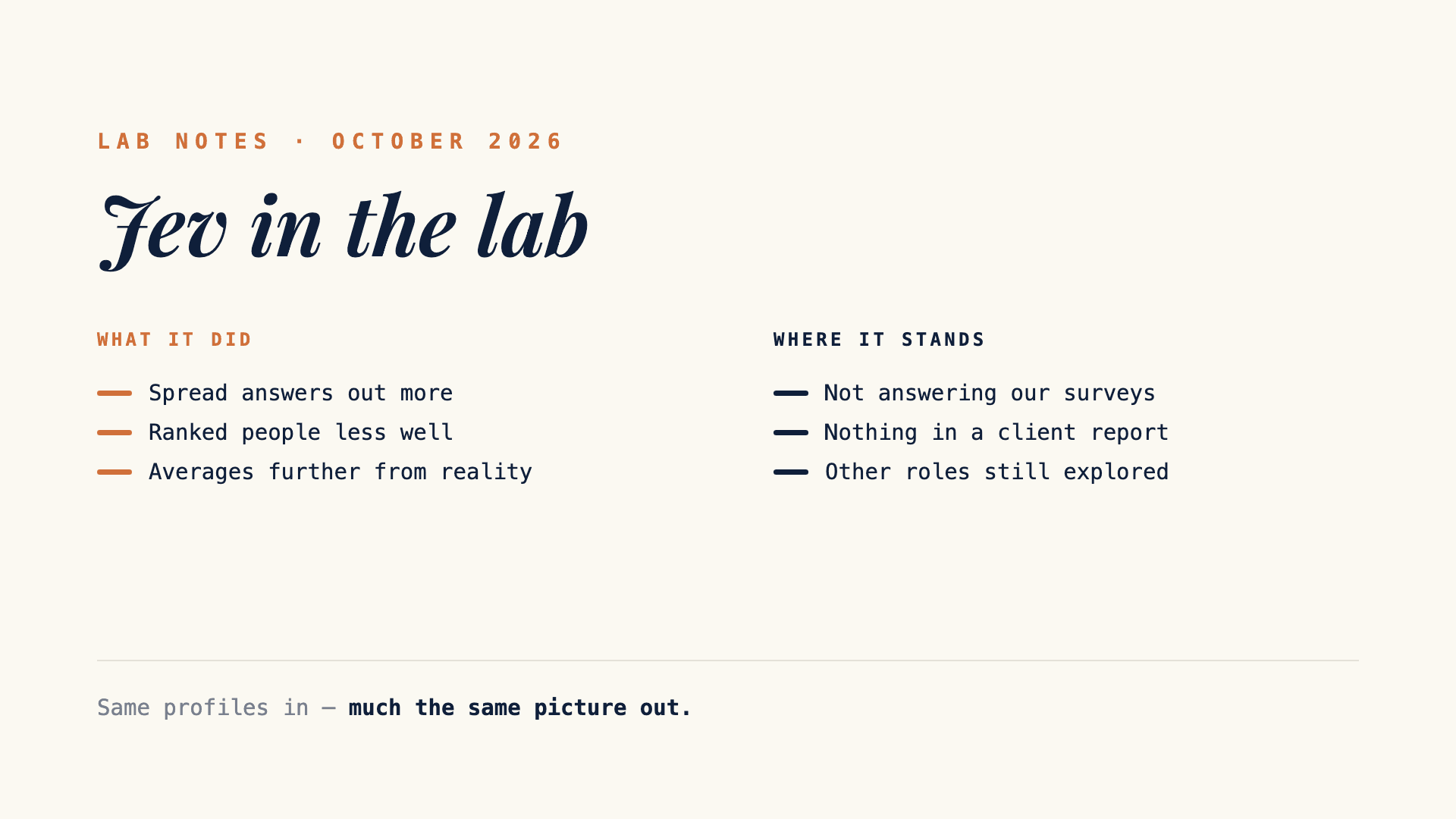
It spread the answers out. In the first run, the distributions overlapped more with those of real people.
But spread is not diversity. A model that is unsure about one respondent produces a wide histogram too. That is not the same as two similar people genuinely disagreeing.
And it did not beat what we already had. In that same first run, its averages moved further from the real survey. In the blind run, it ranked respondents less accurately than our current personas do.
A model can only work with what you give it. Same profiles in, much the same picture out.
That last point is the useful one. Jev saw the same persona description as our current engine. In real survey data, that kind of profile explains only a small share of why one person answers differently from another. No model, however clever, can rank people on information it never received.
So, are we using it?
Not to answer surveys. Nothing in a FlashInsight report is produced by Jev. But “not as a respondent” is not “not at all”: a fast model that makes small, well-defined decisions may have a place elsewhere in a research workflow, steering the process rather than producing the numbers. That is what we keep exploring; no such use is in production.
Our rule does not change. A new model does not touch client results until it has been compared with what we already use and the outcome written up, whichever way it goes. The way we measure that, market by market, is in our note on how reliable synthetic respondents are, and the test anyone can run is in under-dispersion: a test anyone can run.
Questions
What is Jev?
Jev is a decision model released by TypeSafe AI on 15 September 2026. It does not write text: given a situation and a closed question, it returns a probability for each option. It is fast and low-cost to run.
Can Jev be used for market research?
It is a natural candidate for synthetic survey answers, because it returns a spread of probabilities rather than a single answer. In our tests it spread answers out more, but its averages moved further from real survey data and it did not rank respondents better than our existing personas. We do not use it to answer surveys.
Does FlashInsight use Jev in client studies?
No. Nothing in a FlashInsight report is produced by Jev. We keep exploring whether a fast decision model could play another role in a research workflow, without producing the numbers.
Test early. Decide on evidence. Say what you found.
Read next
Evidence: what we have measured · Aaru and Simile on validation · Synthetic respondents: what vendors mean